|
This letter is dated inside Windsor Septr 11th 94 (1794)
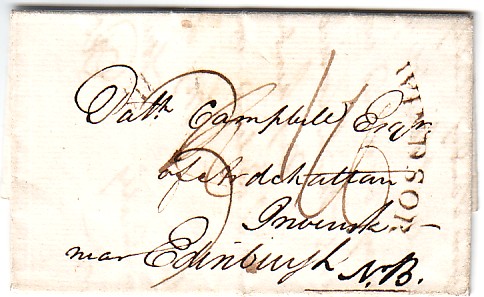
The postmark of WINDSOR is of a type we have not previously seen, being in a convex curve, and it was identified by the seller as being in the first year of use of that town stamp.
The charge mark looks like either 1/0 or 1/6 and then a separate 3 on the left which has been crossed through. At this time the rate for a London to Edinburgh letter was 8d - the Windsor to London rate would have been 3d so it looks as though that charge has been included with the 8d, to make 11d, and then perhaps a 1d local charge from Edinburgh to Inveresk, which is about 5 miles away from that GPO. However, if any reader can make other suggestions I would be delighted to hear from you.
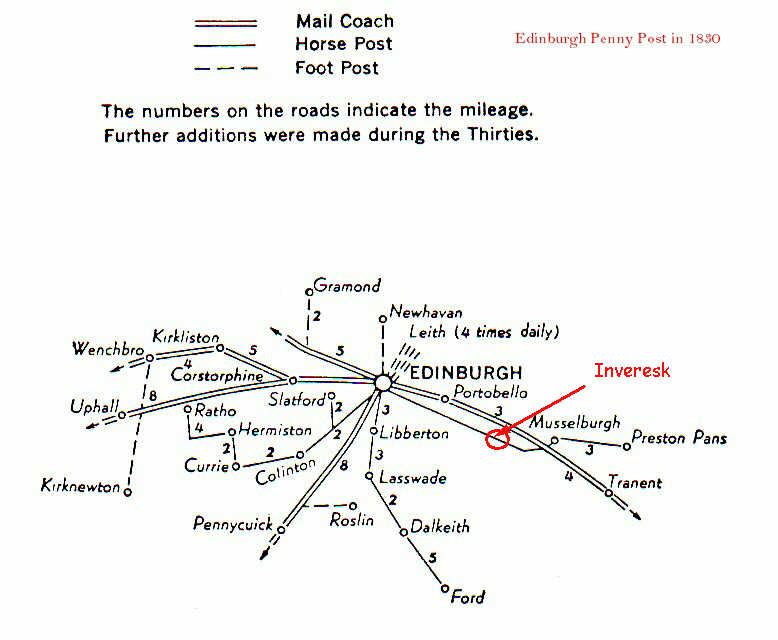
The map in Alan W. Robertson’s book‘Great Britain Post Roads Post Towns and Postal Rates 1635-1839’’ the map of the Edinburgh Penny Post does not show Inveresk, and it is not listed as one of the offices.
On the reverse of the letter are the two date stamps of London and Edinburgh.
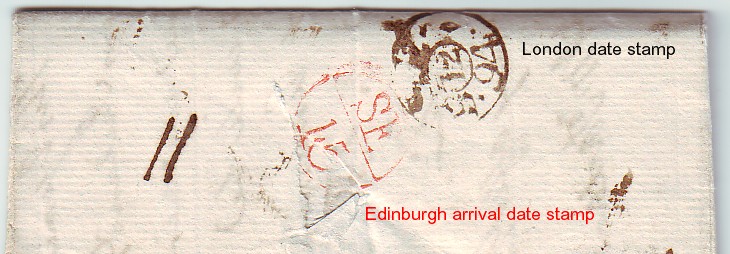
The London date stamp is the type with the year in 2 letters 94 at the bottom of the stamp, date in the middle 12 and the month SE around the outside, and the code letter B at the left (this letter indicated the table at which the letter was sorted, checked and stamped) . This type of date stamp was in use 1791-1794.
These two dated postmarks (or Bishop marks) show the difference in the English and Scottish stamps. The English had been using different types from the time of their introduction, gradually adding different bits to the stamps. In Scotland however, they used only two types, the first from 1693 to 1714, and then the second type from 1714 to 1806. The English starting from 1661 had the stamps made as a single unit, but the economical Edinburgh office did not have a separate date stamp for each day of the year, but had twelve upper halves with the month abbreviated and a diameter, and thirty one lower halves with the numbers “1” to “31” and no diameter.
The two halves were not always exactly the same size, so did not always match up exactly. You can see in this example that there is a break in the outside frame across the centre
The Edinburgh Bishop mark appears to read SE 15 with no year, it was applied where the letter was sealed, so has been torn when the letter was opened. When the letter is folded back as it would have been sent, it is a figure 5. In his book Mailcoach men of the 18th century, Edmund Vale quotes the London to Edinburgh Time bill, which shows the mail coach left London at 8 pm, and arrived at the Edinburgh GPO at 6.a.m. on the 3rd day a total of 57 hours 50 minutes to cover the 396 miles, so the 12 to 15 would be correct.
The letter was addressed to Patk Campbell Esq
Of Ardchattan, Inveresk near Edinburgh N.B.
The N.B. was used to signify, North Britain, rather than Scotland at that time. A search on the web shows that Ardchattan, Inveresk is still there, and there is interesting information about the history of the place.
So now to the letter itself, which is in excellent condition for something more than 200 years old. It begins with a comment which raises another question :- where had he been? The contents are interesting as they show what it took to gain promotion in the army at that time.
Windsor Septr 11th .94
My Dear Sir,
I should have written to you immediately after our arrival in England, but our further destination being then uncertain, I have waited until I could write with certainty. We have received orders to embark for St. Domingo, & will leave this place in a few days for Portsmouth where transports are in readiness.
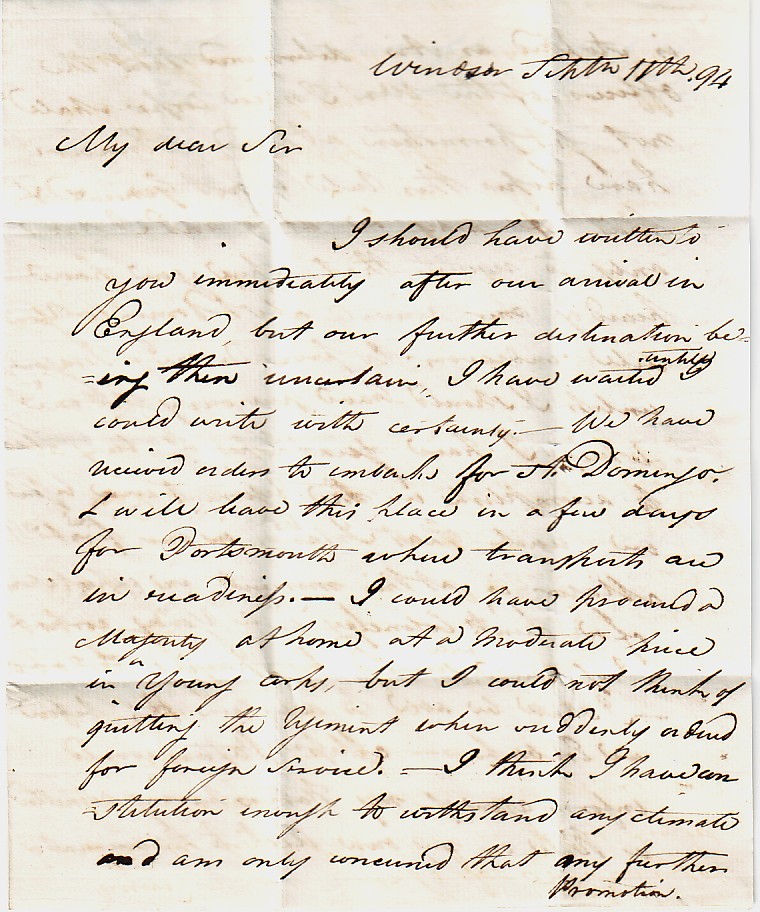
I could have procured a Majority at home at a moderate price in a Young corps but I could not think of quitting the regiment when suddenly ordered for foreign service. I think I have a constitution enough to withstand any climate and am only concerned that any further promotion is stopped as it is determined that the officers of the West India Corps shall not get promotion at home. However, I have hopes that this rule is not General & that it may be done, and I have only to request that.
When you have heard of our arrival at St Domingo you will endeavour to procure me a Majority unless I should have previously got one which I have great hopes of being able to accomplish in the regiment even before we reach that Island as our first Major is at this moment in expectation of a Lieut Colonelcy in a Young corps & I shall be able to ascertain this before we Embark.
Note. This next sentence shows how much it was going to involve, and that they had the funds to purchase the rank of Major.
Messrs Paxtons would inform you of my Father’s having remitted a Bill on my own Acct to the amount of £2012 for the purpose of purchasing it in the Army. I have desired them to have £1500 in readiness, which they have done.
I shall write to you from Portsmouth. I have heard from Sandy lately. His regiment is hourly expected at Bristol from Ireland & I think they may be ordered where ever we are altho’ he seems to think Corsica will be their destination.
My kindest rem…(hole in the paper where it was opened)
to Alex & Mary & Believe me to be
My Dear Sir
Your very affect Nephew
Robt McFarlane
P.S.
I shall expect to hear from you immediately -Direct for Windsor.
Note: Santo Domingo was a port on the Spanish side of the island of Haiti, the other half was held by the French.
The dealer from whom we bought this letter had a note saying in part
Quote
Perhaps part of the well documented fleet of 34 ships of the line heading for the West Indies, after the abolition of slavery.
Unquote.
My research so far has not confirmed this, but I have found information on Wikipedia about the West Indies Regiment (not Corps)
Quote
The West India Regiment (WIR) was an infantry unit of the British Army recruited from and normally stationed in the British colonies of the Caribbean between 1795 and 1927. The regiment differed from similar forces raised in other parts of the British Empire in that it formed an integral part of the regular British Army. and Trinidad & Tobago. Throughout its history, the regiment was involved in a number of campaigns in the West Indies and Africa, and also took part in the First World War, where it served in the Middle East and East Africa.
The WIR soldiers became a valued part of the British forces garrisoning the West Indies, where losses from disease and climate were heavy amongst white troops. The black Caribbean soldiers by contrast proved better adapted to tropical service. They served against locally recruited French units that had been formed for the same reasons. Free black Caribbean soldiers played a prominent and often distinguished role in the military history of Latin America and the Caribbean.
Unquote
This paragraph reinforces the views expressed by the writer of this letter
Quote
Officers
Overall the WIR had a good record for discipline and effectiveness, although there were three mutinies between 1802 and 1837. A factor in these (and a weakness in the WIR during its earlier history) was that it did not always attract a high calibre of British officer. Prevailing social attitudes meant that service with "black infantry" was not a popular option during much of the nineteenth century and many of the more capable officers saw their time with the WIR as simply a stepping stone to more sought after staff or other assignments. The attraction of colonial service was a matter of extra monetary allowances and sometimes better promotion prospects. Prior to 1914 officers had been commissioned into the WIR (as part of the British regular army) on a permanent basis.
Unquote
The following website has a lot of information about the Prince of Wales's Volunteers Regiment.
http://www.lancashireinfantrymuseum.org.uk/the-82nd-prince-of-waless-volunteers-regiment/
by Allan Percival
He gives details of the raising of the Regiment in 1793, and the places in the world where it served. What interested us was the information about the West Indies, which although it was a year later than our letter, showed the conditions which Robert McFarlane and his troops would have faced.
Quote
The 82nd saw brief duty in Windsor and Hampton Court, but was soon posted to Gibraltar in August 1794, not quite a year after its formation. In 1795, the 1st/82nd was ordered to embark for the West Indies where valuable French sugar islands might be captured.
1795 West Indies – Santo Domingo and 1,000 dead.
In early 1795, British attempts to drive the French out of Santo Domingo (now Haiti) were going badly. More than half of the force was stricken by disease, and, in July 1795, badly needed reinforcements were diverted to Jamaica to put down a slave revolt. The arrival of the 82nd in August 1795 permitted a limited offensive. Raw troops, too few of them and virulent disease prevented much success. Nine hundred British soldiers died in eight weeks. By November 1796, the 82nd had fewer than 100 men fit for duty. The wasteful struggle against yellow fever, local insurrections, the French and latterly also the Spanish, lasted until the end of 1797 when the British left the island. The 82nd was posted to Jamaica for a year.
The West Indies were far from the paradise that they have since become. Service in the islands could be little short of a death sentence. Of the 22 officers and 1,000 soldiers of the regiment who had sailed from Gibraltar in 1795, only one officer and 22 men were still with the Colours when, less than four years later, it at last returned to England in January 1799.
Unquote
In fact Robert McFarlane survived his posting, and information on the Clan website shows : A reference to Sir Robert in Maidment’s County Collections published in “The Stirling Sentinel” is as follows:
quote
General Sir Robert Henry Macfarlane KCB, KGH, Colonel of the 89th Regiment of Foot, a gallant and highly distinguished officer, married at Palermo, 10 February, 1815, Maria Gertrude, eldest daughter of C. Henry Vankemper, Captain in the Dutch Navy and Consul of the Netherlands, at Tripoli.
It is recorded of Major General Macfarlane (doubtless Sir Robert) that in 1809, supported by the guns of His Majesty’s ships,“Warrior” and “Success”, he led the British troops with distinguished bravery at the storming and capture of the Island of Ischia in the Bay of Naples, and also at the capture of Procida in 1813. He is also stated to have had a command at the battle of ‘Maiden’ (Maida - 1808).
|