Some Roman roads still survive in England, Watling Street for one, which can be seen from the air as a straight line from London to the north. G.K. Chesterton summed up the English roads with a poem which begins "
Before the Romans came to Rye,
Or out to Severn strode,
The rolling English drunkard
Made the rolling English road.
The roads were just cart tracks, and while Britain was an agricultural country, and people seldom moved far from their villages, that was all that was required. so the state of the roads was not a matter of concern. People walked, and if the roads became impassable by foot, they would know, and could cope with it. But strangers might need to hire a guide to take them to the next village or town.
However, once the life of the country people changed, it was obvious that these roads would have to be improved.
Travel became popular in Georgian times but the dreadful condition of the roads and the likelihood of meeting highwaymen, made it very dangerous.
Sometimes ruts in the road became so deep that travellers were hidden from view and there were potholes where a man might drown on a dark night. In some places, the road disappeared altogether. In wet weather, travellers hired teams of oxen to drag their coach out of the mud, while in the summer the ruts were baked so hard that coaches sometimes turned off into the fields.
It was a legal requirement that each parish had to take care of its own roads. The grandly named "Surveyor of Highways" was in charge. This was one of the locals, chosen by his neighbours. He could command his neighbours to work on the roads (for no pay) for six working days every year. He could also demand the free use of horses, carts and tools from the richer members of the community.
However, with no specialised tools or knowledge, it was not a success.
If enough support could be gained, a Turnpike Trust could be set up by an Act of Parliament to allow the roadmakers to build a tollgate or turnpike at the beginning of their section of road and to charge a toll on all users. This would raise funds to help defray the cost of keeping the road in good repair.
By 1830 there were about 1000 Turnpike Trusts in Britain. Most of them had about
10 or 12 miles of road, though some had many more. By 1840 there were about 15,000
miles of new road and with 8,000 turnpikes to pay for their upkeep. Turnpike Trusts
expected a lot of traffic, so they employed surveyors who knew how to build roads
properly — Thomas Telford and John Macadam were two successful road builders.
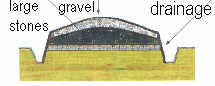
Thomas Telford's innovative road making system involved drainage.
First a well-drained base, then a layer of large stones, finally a layer of gravel to make a smooth surface.
When coach owners saw the new roads, they made much better coaches. They were light, well sprung, and comfortable. They would rattle along at 20 mph and keep an average speed of 12mph. People could now go to places in one fifth of the time it had taken before. London to
Edinburgh, for example, now took 2 days instead of 10.
The Coaching Era :-
On Macadam's new roads travel by night became more common
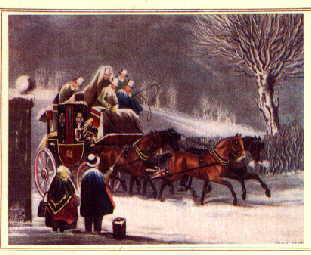 | In the last 30 years of the Georgian period 1800-1830, traffic increased in speed and numbers beyond anything which had ever been known. Over 1000 vehicles left London every day, using altogether about 4000 horses. 15 kilometres on — in all directions — and at stages all over the country, hundreds more horses were waiting to relieve them. |
The most important vehicles on the new roads were the stage coaches which made regular runs between London and most large towns. They stopped at stages along the road to put down and collect passengers, to change horses, and to stay for the night at an inn.Horses were changed about every 15 kms at the stages, which were Inns, each keeping a large number of horses for hire to the coach companies. While the horses were being changed in the yard, bustling with grooms, ostlers and postboys, passengers had a chance to stretch their legs. In winter they warmed their numbed fingers and took a glass of ale or steaming punch at the Inn's fireside.
As the coach drew near to its Inn the guard sounded his horn. Fresh horses were brought out ready and were changed with all due speed. There was time now only for a bite of food and a hasty pull at a mug of ale, before the coach was off again. Traffic grew so great that at Hounslow, near London, for instance, a famous coaching centre with many Inns, 2500 horses were kept for posting. Large inns could stable as many as 600 horses.
"The stagecoach was a heavy vehicle, pulled by four or six horses, and travelled at a steady eight kilometres per hour. Inside the coach were two cushioned seats, taking three persons on each side. Outside passengers travelled at a cheaper rate, either in the luggage basket,(*) which was slung between the back wheels, or on the roof, clinging to the baggage. It is difficult to say which was the more uncomfortable way of travelling."
(Quoted from 'Queen Anne to Queen Victoria' by R.J. Unstead)
(*) This was the origin of the phrase "in the basket", to denote being short of money.
However, there were many other stage coaches, run more especially for the carriage of freight. They were usually hired at a specific charge for a double mile ( that is there and back), by private companies with their own distinctive liveries and colours. Some of these are quoted in the letters, such as "Blossoms", "Regent", "Emerald" etc., and often the Inn is quoted from where the company had its headquarters, or an office.
"The stage coaches went faster and faster, and the sight of them varnished and shining, their splendid horses driven by skillful coachmen filled men with excitement and pleasure. Some men indeed spent much of their time riding in any new coach, on any fast run, for the sheer joy of it.
Their coaches all had names like Magnet, Comet, Express, Lightning, Greyhound and Rocket, and each had it's rival belonging to another company which would race neck and neck along Macadam's smooth roads. Speed was everything, and the drivers took a pride in arriving punctually, at every stage."
(Quoted from 'Queen Anne to Queen Victoria' by R.J. Unstead)
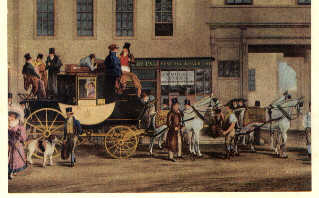 the Blenheim Coach, c 1831
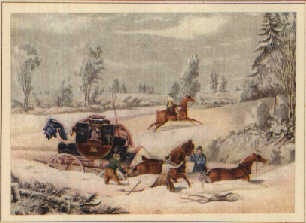
This engraving of 1825 'The Mail Coach in a drift of snow', engraved by R.G. Reeve after James Pollard (1925), shows the hazards to be encountered travelling in the winter-time. It is hard to see that a road exists at all. The mail coach drivers were expected to keep to their time bills even in such conditions.